
 Posted by
| Quick Read
OSHA requires permanent aisles and passageways in warehouses to be marked (29 CFR 1910.176). OSHA mandates only red (fire/emergency) and yellow (caution) — every other color follows ANSI Z535.1 best practice. Line width: minimum 2 inches; 2–6 inches recommended. 4 inches is a common forklift-aisle spec. Aisle width: minimum 4 feet, or equipment width plus 3 feet — whichever is greater. Replace markings when: more than 25% is faded, peeling, or obscured. Best tape for forklift aisles: heavy-duty abrasion-resistant tape (e.g., Armadillo). Standard PVC tape will shred under heavy traffic. |
Floor markings are the silent traffic system of every warehouse. They tell forklifts where to drive, pedestrians where to walk, where to stage pallets, where the eyewash station is, and which areas to keep clear in an emergency. Done right, a warehouse floor marking system reduces accidents, speeds up operations, and keeps you on the right side of OSHA. Done wrong — faded lines, mixed colors, no system at all — and you’ve created a hazard instead of preventing one.
This warehouse floor marking guide walks through everything a facility manager, EHS lead, or operations supervisor needs to plan, install, and maintain a compliant system: OSHA and ANSI standards, color codes, line widths, the right tape for the job, and how to lay out aisles, hazards, and 5S zones without redoing the work in six months.
What OSHA Requires for Warehouse Floor Marking
OSHA does not publish a single, prescriptive floor marking rulebook. Instead, the requirements live across a handful of standards and interpretation letters. The most important ones for a warehouse:
29 CFR 1910.176(a)
Materials Handling and Storage
Where mechanical handling equipment (forklifts, pallet jacks, reach trucks) is used, permanent aisles and passageways must be appropriately marked. Aisles and passageways must be kept clear, in good repair, and free of obstructions that could create a hazard.
29 CFR 1910.22
Walking-Working Surfaces
Requires walking and working surfaces to be kept clean, orderly, sanitary, and in safe condition. This is the general housekeeping rule that floor markings help you comply with.
29 CFR 1910.144
Safety Color Code
This is OSHA’s color rule, but it’s narrower than most facility managers assume. It only mandates two colors: red for fire protection equipment, flammable liquid containers, and emergency stops; and yellow for caution — physical hazards like striking against, stumbling, falling, tripping, and “caught in between.”
29 CFR 1910.37
Means of Egress
Exit routes must be kept clear and properly marked. In buildings with floors more than 75 feet above the lowest level of fire department access, luminous egress path markings are required under the IFC.
In a 1972 OSHA interpretation letter, the agency clarified that aisle lines can be any color and any pattern (dots, dashes, squares, or continuous), provided the aisle is clearly defined. So while OSHA gives you flexibility, your facility still needs a consistent, documented system — that’s where ANSI comes in.
ANSI Floor Marking Color Code
ANSI Z535.1 provides the safety color framework most warehouses build their system around. ANSI doesn’t mandate floor colors specifically, but its safety-sign palette is the de facto standard for marking floors consistently across U.S. facilities.
A common color system for warehouse floor marking:
| Color | Use |
| Yellow | Aisleways, traffic lanes, work cells |
| White | Equipment and fixtures not otherwise color-coded (workstations, carts, racks) |
| Blue, Green, Black | Raw materials, work-in-progress, finished goods |
| Orange | Materials or product held for inspection |
| Red | Defects, scrap, rework, fire equipment, emergency stops |
| Red & White | Areas to be kept clear for safety/compliance (electrical panels, eyewash stations, fire extinguishers) |
| Black & White | Areas to be kept clear for operational purposes |
| Black & Yellow | Areas exposing employees to physical or health hazards |
The most important rule: pick a system and apply it consistently across the entire facility. A red line that means “fire equipment” in shipping and “scrap bin” in receiving will get someone hurt. Document your color legend, post it where employees can see it, and include it in new-hire training.
OSHA Aisle Width and Line Width Requirements
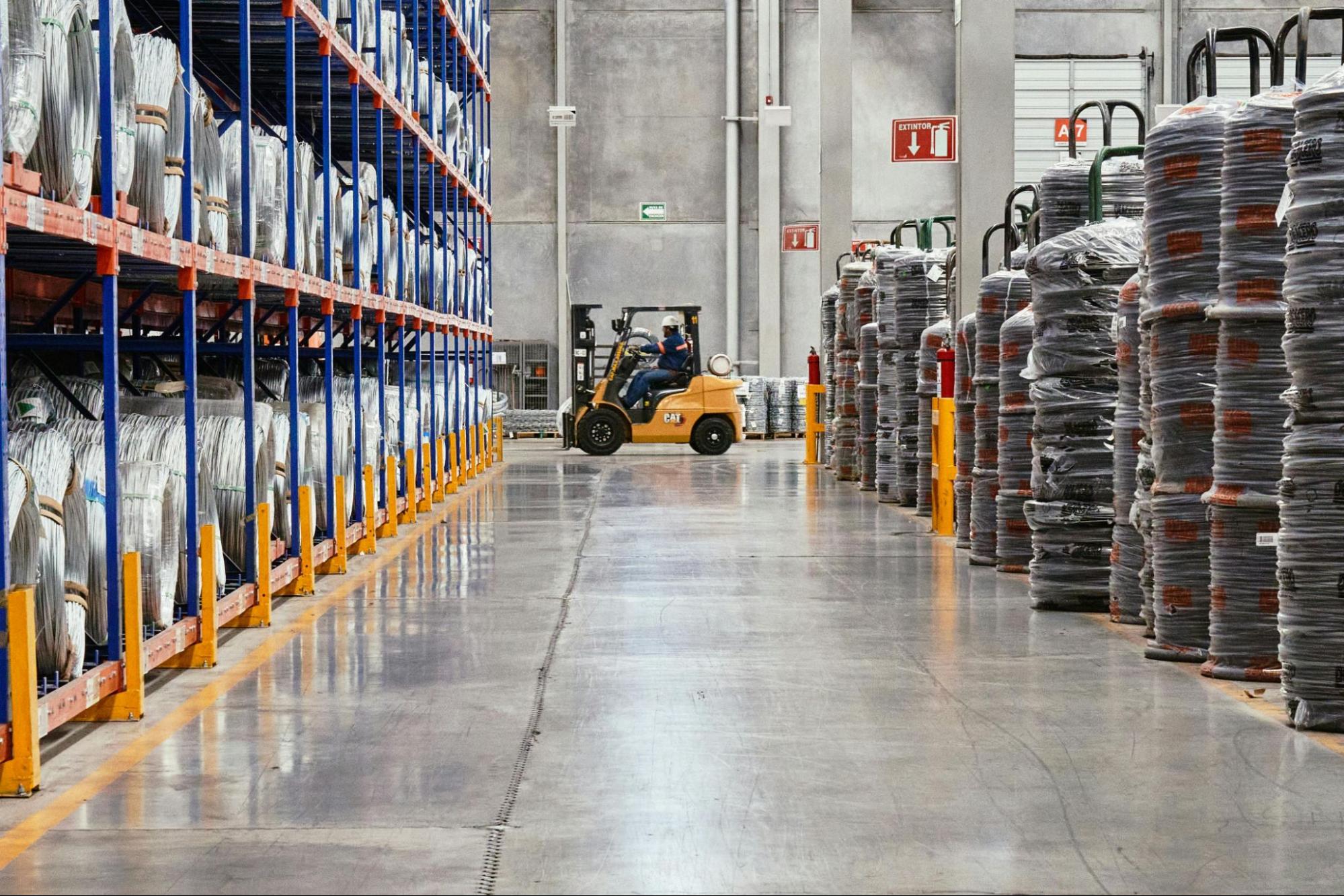
OSHA’s interpretations give specific dimensions that hold up under inspection:
- Line width: Floor marking lines must be at least 2 inches wide. OSHA recommends a range of 2 to 6 inches. For high-traffic forklift aisles, wider is better — 4 inches is a common spec.
- Aisle width: Aisles must be at least 4 feet wide, or at least 3 feet wider than the largest piece of equipment that uses the aisle. A 7-foot-wide reach truck needs at least a 10-foot aisle.
- Replacement threshold: Industry best practice is to replace or repaint floor markings when more than 25% of the marking is obscured, peeling, or faded. Faded markings can be worse than no markings — they create ambiguity in fast-moving environments.
- Egress and step markings: Where applicable, solid stripes must run along the leading edge of each step, fully across the tread, and edge markings should sit within about 4 inches of the wall.
What to Mark in a Warehouse
A complete floor marking plan typically covers:
- Forklift and pedestrian traffic lanes. Separate them wherever possible. Mixed traffic is the single biggest source of struck-by injuries in warehouses.
- Pedestrian walkways at intersections. Use a contrasting color and consider crosshatch patterns.
- Loading dock edges and drop-offs. Red or red/white striping plus physical guards.
- Staging and storage zones. L-corners or T-markers work better than full rectangles — they show the footprint without trapping debris along the lines.
- Equipment footprints. Pallet jack parking, charging stations, mop stations, ladder storage.
- Safety equipment clearances. Eyewash stations, AEDs, fire extinguishers, electrical panels — OSHA requires 36 inches of clear space in front of electrical equipment, and that clear space should be marked.
- Hazard zones. Areas with overhead doors, swinging gates, low clearances, or active machinery.
- Quality and 5S zones. Inspection holds, rework areas, scrap, and finished goods staging.
Walk the facility and map it before you order tape. The most common mistake is buying a single color in a single width and trying to make it work everywhere.
Floor Marking Tape vs. Paint vs. Floor Signs
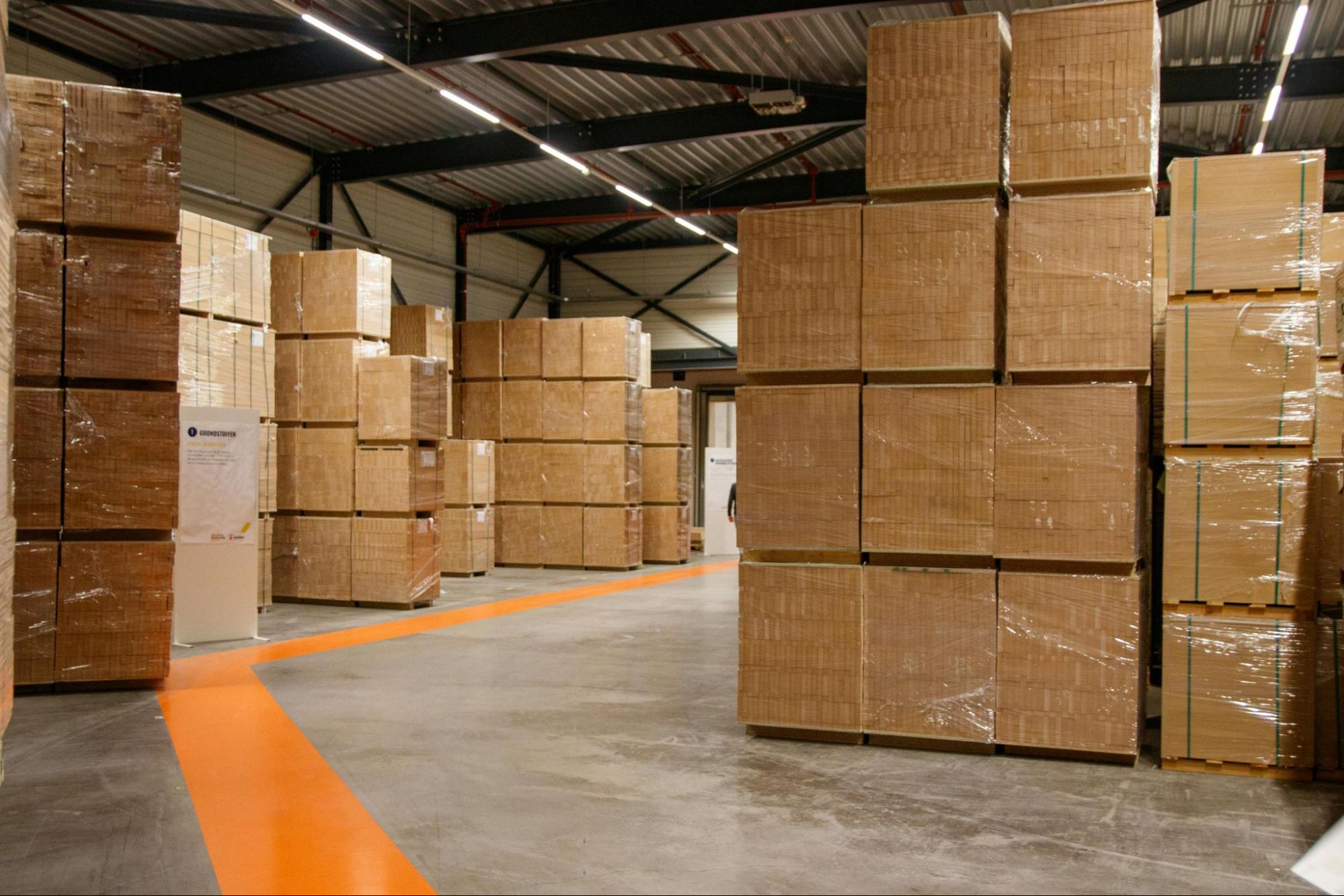 Each method has a place, and most warehouses use a combination.
Floor Marking Tape
For most warehouse applications, industrial-grade floor marking tape is the right answer. Compared to paint, tape is fast to install (no curing time, no facility shutdown), easy to replace when worn or when layouts change, and available in OSHA color combinations off the shelf. The key spec to look for is durability — standard PVC hazard tape works in light-duty areas, but high-traffic forklift aisles need heavy-duty tape engineered for the load.
Heavy-duty options like Koffler’s Armadillo heavy-duty floor marking tape use a tough abrasion-resistant coating that holds up under repeated forklift traffic where standard tape would shred within weeks. For aisle definition on smoother floors, a standard aisle marking tape in an OSHA color is usually sufficient. For hazard-warning areas, black and yellow hazard tape is the standard call.
To extend the life of tape in high-wear areas, a clear self-laminating overlay tape applied over your markings adds significant durability and slip resistance with minimal effort.
Paint
Epoxy paint creates the longest-lasting marking and is the right call for outdoor areas exposed to weather, or for permanent layouts that aren’t going to change. The trade-offs: surface prep is significant (the concrete needs the right Concrete Surface Profile to bond properly), curing takes the floor out of service for hours or days, and any layout change means grinding it off.
Floor Signs and Decals
For pictograms, custom messages, directional arrows, and pedestrian crossings, anti-slip safety floor signs fill the gap that lines can’t. Use them at intersections, in front of safety equipment, and anywhere a worker needs more than a color cue. Reflective and glow-in-the-dark options are valuable in poorly lit areas and for emergency egress routes — particularly any area where lighting could fail.
Tape vs. Paint vs. Decals at a Glance
| Factor | Floor Marking Tape | Epoxy Paint | Floor Signs / Decals |
| Install time | Minutes per run; no curing | Hours per run + 12–24 hr cure | Seconds each; peel-and-stick |
| Facility downtime | None to minimal | Zone closed during cure | None |
| Lifespan (heavy traffic) | 6 mo – 2+ yr (heavy-duty grade) | 3–5+ years | 1–3 years depending on grade |
| Cost to install | $ – $$ | $$$ (prep + labor) | $ per piece |
| Layout changes | Easy — peel and re-tape | Hard — must grind off | Easy — peel and replace |
| Surface prep needed | Clean, dry, degreased | Cleaned + correct CSP profile | Clean, dry, degreased |
| Best for | Aisles, staging, 5S zones, hazard borders | Permanent outdoor layouts; never-changing zones | Pictograms, messages, walkway markers, safety equipment cues |
| Best for forklift lanes? | Yes — heavy-duty grade only | Yes — if permanent layout | No — supplements only |
| Visibility in low light | Reflective and glow options available | Standard; glow additives possible | Reflective and glow versions standard |
Most warehouses use all three: heavy-duty tape for aisles, decals for pictograms and safety equipment, and epoxy paint only where the layout is permanent and the wear is extreme.
Surface Preparation: The Step Most Facilities Skip
Tape and paint both fail for the same reason: a contaminated surface. Before any marking goes down:
- Sweep and vacuum the area thoroughly.
- Degrease with an industrial cleaner to remove oil, hydraulic fluid, and other contaminants. This is non-negotiable on warehouse floors.
- Let the floor dry completely. Even slight residual moisture will compromise adhesion.
- For tape: apply firm pressure with a rubber roller to activate the adhesive. Do not just press by foot.
- For paint: verify the concrete surface profile and prime if the manufacturer specifies it.
A facility that skips degreasing will be replacing tape within a month. A facility that does it right will get a year or more out of the same tape in the same location.
Implementing a Warehouse Floor Marking System: Step by Step
- Walk and map the facility. Identify traffic flows, hazards, equipment locations, storage zones, and safety stations.
- Define your color legend. Document which color means what, then post it where employees can see it.
- Measure aisles for compliance. Confirm aisle widths meet the 4-foot minimum or the equipment + 3 feet rule, whichever is greater.
- Choose materials by zone. Heavy-duty tape for forklift aisles, standard tape for low-traffic areas, decals for messaging, paint for permanent outdoor markings.
- Prep the surface. Sweep, degrease, dry. Every time.
- Install during a planned downtime window. Tape installs quickly, but you still want clear floors and good lighting.
- Train every employee. New hires, temps, contractors, and visitors all need to understand the system.
- Audit during 5S walks. Replace anything that’s more than 25% degraded, and update the layout as the floor plan changes.
Common Mistakes to Avoid
- Inconsistent color use across the facility. Same color must mean the same thing everywhere.
- Lines too narrow for the application. A 2-inch line is the minimum, not the goal, for a busy aisle.
- Cheap tape in forklift lanes. Standard PVC tape will not survive heavy-duty traffic. Spec the right grade for the load.
- Marking over dirty floors. The single biggest reason floor marking fails early.
- No documented legend. If a new shift supervisor can’t tell what your colors mean, neither can OSHA.
- Forgetting clear zones in front of electrical panels and safety equipment. Required by 1910.303 (electrical) and good practice everywhere else.
- Letting markings fade past the point of legibility. Faded markings are an inspection finding waiting to happen.
Frequently Asked Questions
Does OSHA require specific floor marking colors?
No. OSHA mandates red and yellow for specific hazards under 29 CFR 1910.144, but does not require any specific color for aisles. A 1972 interpretation letter confirmed that aisle lines may be any color so long as the aisle is clearly defined. Most facilities adopt the ANSI Z535.1 color palette for consistency. For a deeper look at how color marking fits into a wider safety system, see our Top 10 Floor Protection Products guide.
How wide do warehouse floor marking lines need to be?
At least 2 inches wide, with OSHA recommending 2 to 6 inches. Four inches is a common spec for forklift aisles, where wider lines stay visible longer under heavy wheeled traffic. Pair high-traffic aisle lines with non-slip safety tapes on ramps and transitions to round out the system.
How wide do warehouse aisles need to be?
At least 4 feet wide, or at least 3 feet wider than the largest piece of equipment that uses the aisle — whichever is greater. If your aisles cross slab joints or expansion gaps, those transitions also need protection; see our guide to expansion joints and covers for the right hardware.
When should I replace floor marking tape?
When more than 25% of the marking is obscured, peeling, faded, or otherwise unreadable. Build inspections into your regular 5S audits and replace as part of routine maintenance — faded markings are an inspection finding waiting to happen. For floor protection products that hold up alongside marking tape, our Top 10 Floor Protection Products breakdown is a useful companion.
Is tape or paint better for warehouse floors?
For most indoor warehouse applications, industrial floor marking tape is faster, cheaper, and more flexible than paint. Paint makes sense for permanent outdoor markings or layouts that will never change. Many facilities use both — and add commercial entrance mats at dock doors and entry points to catch the grit that wears tape down fastest.
What color marks a fire extinguisher area?
Red, per OSHA 1910.144. The clear zone in front of the extinguisher is typically marked with red/white striping to keep it from being blocked. A documented color legend should cover this and other safety-equipment clearances facility-wide.
Where should I install non-slip products alongside floor marking?
Floor marking tells people where to go; non-slip tape keeps them upright once they’re there. Install non-slip products on ramps, dock plates, stair treads, and any zone where moisture, oil, or grease are common. Our 6 Best Non-Slip Tapes for 2026 guide covers the right grade for each application.
Build the System Once, Maintain It Forever
A good warehouse floor marking system pays for itself in fewer near-misses, faster picking, cleaner 5S audits, and a smoother OSHA inspection. The work is mostly upfront: map the facility, document the legend, prep the surface, and spec the right tape for each zone. After that, maintenance is just walking the floor, replacing what’s worn, and updating the layout as operations change.
Koffler Sales has spent over 50 years supplying floor and wall protection products to commercial and industrial facilities. Explore our full selection of floor marking tape, hazard tape, and anti-slip safety products to spec the right materials for your warehouse.