
 Posted by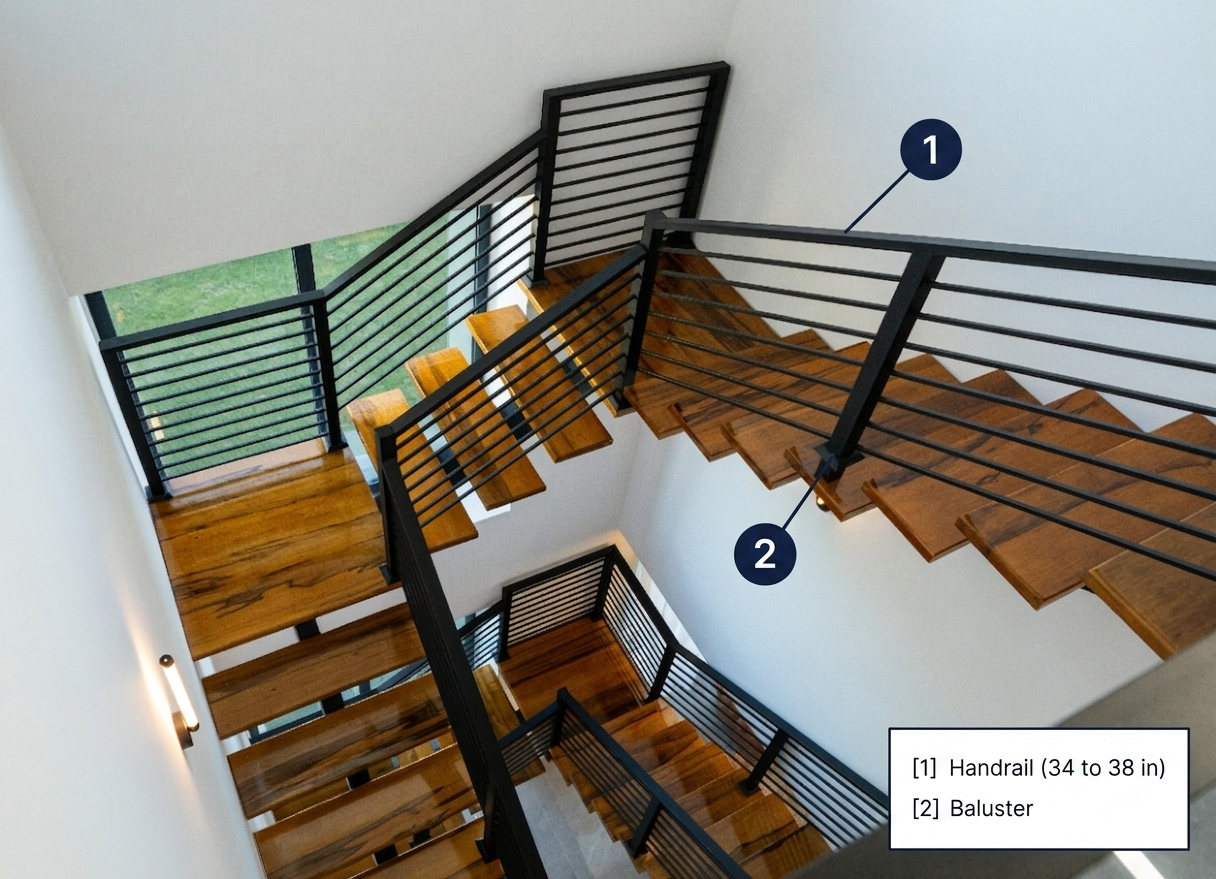
A handrail at the wrong height isn’t just uncomfortable. It’s also a code violation, a safety risk, and a potential lawsuit waiting to happen. So whether you’re building a new staircase, renovating a hallway, or installing a corridor handrail in a commercial space, you need to nail the height the first time.
This handrail height guide breaks down every code requirement in plain English. We cover IRC, IBC, OSHA, and ADA standards, plus the differences between residential, commercial, and industrial settings. By the end, you’ll know exactly where to mount your handrail and which products fit your project.
Quick Answer: Handrails must sit between 34 and 38 inches above the stair nosing or walking surface. This range applies to both residential (IRC) and commercial (IBC) buildings. OSHA allows a slightly wider range of 30 to 38 inches for industrial sites.
Why Handrail Height Matters So Much
Handrails do one job above all others. They keep people from falling. The right height puts the rail where most adults can grab it without bending or reaching. Too low, and tall people stoop. Too high, and shorter folks lose leverage.
Codes also exist because falls on stairs send hundreds of thousands of Americans to the ER each year. The 34-to-38-inch range comes from decades of research on how people actually catch themselves mid-slip. So when you follow the code, you’re following data, not just rules.
Plus, building inspectors test handrail height with a tape measure on every job. If yours sits at 33 inches or 39 inches, you’ll fail the inspection. Period.
The Big Four: Codes That Govern Handrail Height
Four major codes apply to handrails in the United States. Each one covers different building types and use cases. Let’s break them down.
1. International Residential Code (IRC)
The IRC governs single-family homes, two-family homes, and townhouses up to three stories. It’s the standard most homeowners and contractors deal with on residential projects.
For handrail height, the IRC requires the gripping surface to sit between 34 and 38 inches measured vertically from the stair nosing. The IRC also requires a handrail on at least one side of any stairway with four or more risers.
2. International Building Code (IBC)
The IBC covers commercial, multi-family, educational, and most non-residential buildings. It’s stricter than the IRC in many ways, but the handrail height range matches: 34 to 38 inches above the stair nosing.
The big difference? The IBC requires handrails on both sides of most stairs. It also adds requirements for intermediate handrails on wide staircases, with a maximum spacing of 60 inches between rails.
3. OSHA (Occupational Safety and Health Administration)
OSHA covers workplaces, including factories, warehouses, and industrial facilities. Their handrail rules differ slightly from the IBC.
OSHA allows handrail height between 30 and 38 inches above the leading edge of the stair tread. So the bottom of the range drops 4 inches lower than the IBC standard. OSHA also requires a separate 42-inch top rail for fall protection on stair rail systems installed after 2017.
4. Americans with Disabilities Act (ADA)
The ADA isn’t a building code. It’s a civil rights law that sets accessibility standards. Most modern building codes incorporate ADA requirements, but ADA also applies independently to public spaces.
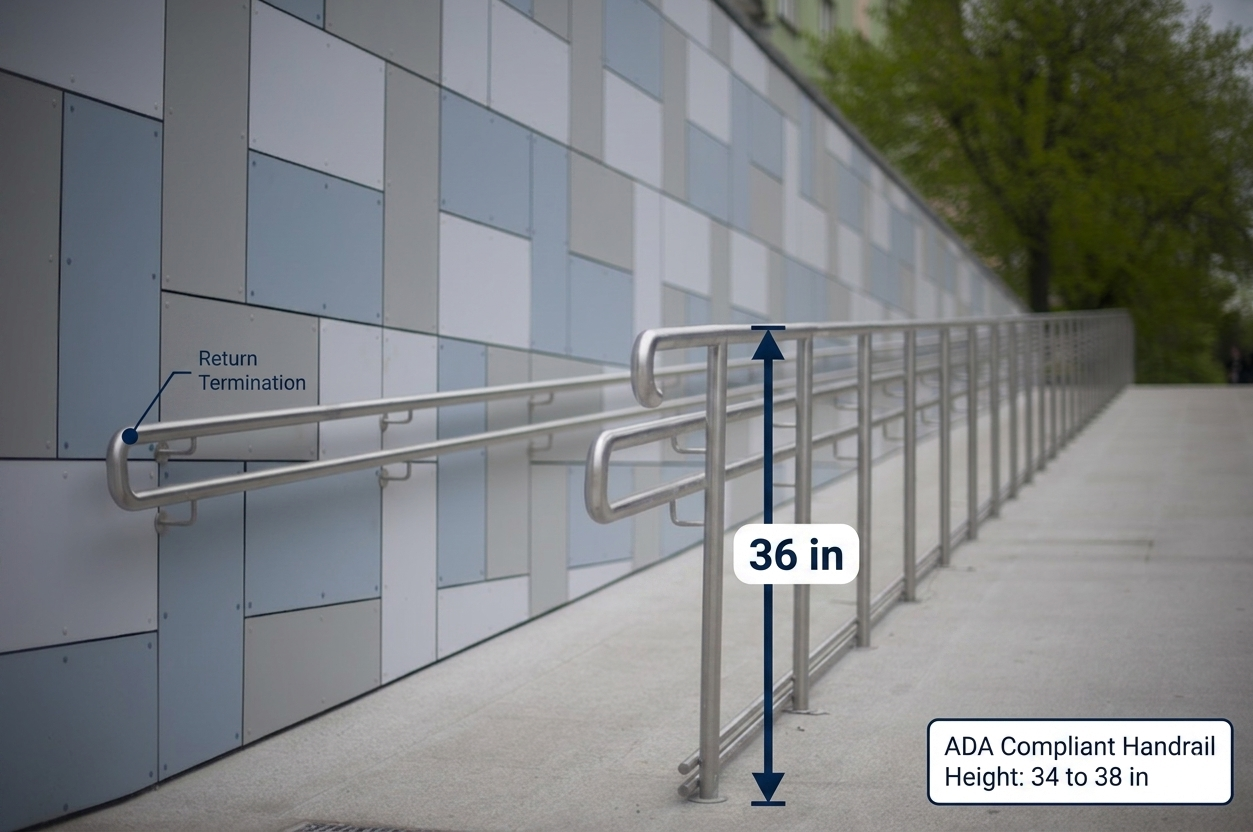
ADA handrail height matches the IBC: 34 to 38 inches above the stair nosing or ramp surface. The ADA adds extra rules for graspability, continuous gripping surfaces, and required extensions at the top and bottom of stairs.
Handrail Height Code Requirements at a Glance
Here’s a side-by-side comparison of the four major codes:
| Code | Min Height | Max Height | Both Sides Required? | Typical Use |
|---|---|---|---|---|
| IRC (Residential) | 34 inches | 38 inches | No (one side OK) | Single-family homes, townhouses |
| IBC (Commercial) | 34 inches | 38 inches | Yes | Offices, retail, multi-family, schools |
| OSHA (Industrial) | 30 inches | 38 inches | Varies by stair type | Factories, warehouses, workplaces |
| ADA (Accessibility) | 34 inches | 38 inches | Yes (on accessible routes) | Public buildings, ramps, accessible stairs |
Pro tip: When in doubt, install at 36 inches. This sits in the middle of every code range and works for nearly every building type. It’s the safest default for any project.
Handrail Height by Project Type
Different settings have slightly different rules. Here’s what to install in common project types.
Residential Stair Handrail Height
For interior or exterior stairs in a home, install your handrail at 34 to 38 inches above the stair nosing. Most builders aim for 36 inches to give a comfortable grip for everyone in the family.
You only need a handrail on one side of the stairs. But adding a second rail makes climbing easier for kids, seniors, and anyone carrying groceries. So consider doubling up if the budget allows.
For the math: measure straight up from the leading edge of each step (the nosing), not from the back of the tread. The height must stay uniform along the entire run.
Commercial Stair Handrail Height
Commercial buildings follow the IBC. Install handrails on both sides of every stair at 34 to 38 inches above the nosing.
For wide stairs (typically over 88 inches), you’ll need intermediate handrails so all parts of the stair sit within 30 inches of a graspable rail. This rule keeps anyone from being stranded in the middle of a wide flight without support.
For high-traffic commercial corridors and ramps, our plastic handrails standard series deliver durable PVC construction with aluminum brackets. They install easily and hold up to constant use in hospitals, schools, and office buildings.
Industrial and Workplace Handrail Height
OSHA gives you a wider window: 30 to 38 inches above the tread. Most industrial installations land at 36 inches for consistency with commercial buildings on the same site.
For stair rail systems installed after January 17, 2017, OSHA requires both a top rail at 42 inches and a separate handrail at 30 to 38 inches. So you’ll have two rails: one for fall protection, one for support.
ADA-Compliant Handrail Height
For any public space or building open to the public, ADA applies. Install handrails at 34 to 38 inches above the stair nosing or ramp surface.
ADA also adds these rules:
- Handrails on both sides of stairs and ramps
- Continuous gripping surface along the entire run
- Required extensions at the top (12 inches horizontal) and bottom (one tread depth, then horizontal)
- Smooth, returned ends so clothing can’t snag
For ADA-compliant grab bars in bathrooms and accessible spaces, browse our full grab bars collection. We carry straight, angled, folding, and floor-to-wall styles that exceed ADA standards.
Deck Handrail Height
Deck handrails fall under the IRC for residential properties. Install them at 34 to 38 inches above the deck stair nosing. The deck guard rail itself (the rail around the perimeter of the deck) is different and follows separate rules.
Per IRC R312, residential decks 30 inches or less above grade don’t require a guard at all. Decks more than 30 inches above grade require a guard rail at least 36 inches tall. So in residential settings, the IRC sets one minimum: 36 inches when a guard is needed.
The 42-inch guard rail you’ll see referenced often comes from the IBC, which governs commercial decks, multi-family balconies, and similar non-residential applications. So a single-family home deck follows the 36-inch IRC rule, but an apartment building balcony or a restaurant patio deck follows the 42-inch IBC rule.
So a deck staircase actually has two heights to think about: the stair handrail (34-38 inches above nosing) and the deck guard (36 inches under IRC for homes, 42 inches under IBC for commercial).
Other Critical Handrail Requirements You Can’t Ignore
Height is just one rule. Codes also specify graspability, extensions, returns, and clearance. Skipping these creates real safety hazards and code violations.
Graspability: How the Handrail Should Feel in Your Hand
Codes require handrails you can actually grab. For circular handrails, the outside diameter must measure between 1¼ inches and 2 inches. This range fits the average adult hand for a strong “power grip” rather than a weak “pinch grip.”
Non-circular handrails (square, oval, or shaped) must have a perimeter between 4 and 6¼ inches with a maximum cross-section of 2¼ inches. Anything bigger and your fingers can’t wrap around it properly.
Wall Clearance
Handrails need at least 1½ inches of clearance between the rail and the wall. This space lets you wrap your hand fully around the rail without scraping your knuckles.
Handrail Extensions
For ADA-compliant stairs and ramps, handrails must extend past the top and bottom risers:
- Top: 12 inches horizontally beyond the top riser
- Bottom: One tread depth, then continue horizontally
These extensions give users something to hold onto as they transition from the slope to the landing. They prevent the most common stumble: letting go too early at the top or grabbing too late at the bottom.
Handrail Returns: The Most Overlooked Code Requirement
Here’s the rule contractors miss most often. Handrail ends must “return” to the wall, post, or floor. They can’t just stop in mid-air.
Why? An open-ended handrail catches loose clothing, purse straps, and even firefighter turnout gear. People have died because their pocket caught on a railing as they descended stairs.
Inspectors flag this all the time. As one building inspector put it, an open handrail termination is “one of the most overlooked citable conditions in the field.”
So when your handrail ends, curve it back to meet the wall. Or terminate it in a newel post. Or run it into a guardrail. Just don’t leave it hanging.
Common Handrail Mistakes (And How to Avoid Them)
After 50+ years helping customers spec handrails, we’ve seen every mistake in the book. Here are the ones that cost the most in failed inspections, lawsuits, and re-installs.
1. Measuring From the Wrong Spot
The code measures handrail height from the stair nosing (the leading edge of each step), not from the back of the tread. People mess this up constantly.
If you measure from the wrong spot, your “36-inch” handrail might actually sit at 34 or 38 inches when measured correctly. Always start from the nosing.
2. Inconsistent Height Along the Run
The handrail must stay at a uniform height for the entire flight. So if you start at 36 inches at the top, you need to end at 36 inches at the bottom (measured from each nosing).
Walls aren’t always plumb, and stairs aren’t always perfectly built. So check with a laser level along the full run before you mount brackets.
3. Forgetting the Wall Clearance
A handrail mounted flush to the wall fails inspection. You need at least 1½ inches of space behind the rail. Most handrail bracket systems include this clearance built-in, but DIY installs sometimes get it wrong.
4. Leaving Open Ends (No Returns)
As we mentioned, open handrail ends violate code and create snag hazards. Always return your handrail to the wall, a post, or the floor. This single fix eliminates one of the top causes of stair injuries.
5. Picking the Wrong Diameter
A 2×4 nailed sideways is not a handrail. Neither is a 3-inch chunky cap rail. Both are too big for a real grip. Stick with diameters between 1¼ and 2 inches for round handrails.
For a sleek profile that hits the right diameter and exceeds ADA standards, check out our plastic designer series handrails. They come in 4 designs and 60 colors, so you can match any decor.
6. Confusing Guardrails With Handrails
A guardrail prevents you from falling off an edge. A handrail gives you something to grip while climbing. These are not the same thing, and they have different height requirements.
Guardrails sit at 36 inches under the IRC (residential) or 42 inches under the IBC (commercial). Handrails sit at 34 to 38 inches in both. Some installations need both, with the guardrail providing fall protection and a separate handrail providing grip.
7. Skipping the Required Number of Sides
The IRC lets you install one handrail on residential stairs. The IBC requires handrails on both sides of commercial stairs. The OSHA rules vary by stair type. Check your code before you order materials.
Pro Tips You Won’t Find About Handrails Anywhere Else
Here’s the insider stuff you won’t find in a typical big-box DIY post.
Tip 1: Mount Brackets Before Cutting
Mark your bracket locations and pre-drill the holes before you cut your handrail to length. This way, you can dry-fit the rail to confirm everything aligns. It’s far easier to adjust a hole than to fix a mis-cut rail.
Tip 2: Use a Story Pole for Multi-Floor Installs
When installing handrails across multiple flights, build a “story pole” (a long stick marked with bracket locations) instead of measuring each one separately. This guarantees consistent height across every floor.
Tip 3: Account for Carpet Thickness
If you’re installing on a carpeted stair, measure handrail height from the finished surface of the carpet, not the bare wood. The new carpet adds about 1/2 to 3/4 inch of height, which can push your rail outside the legal range if you measure it from bare wood.
Tip 4: Choose Materials Based on the Environment
Wood handrails look classic but need refinishing every few years. Metal lasts longer but feels cold. PVC and rigid vinyl resist moisture and chemicals, which makes them ideal for healthcare, schools, and food service.
For high-traffic commercial corridors that double as both protection and grip surface, our plastic handrails with crash rail integration (the HRB-20 series) function as combined handrail and crash rail. You get safety plus wall protection in one product.
Tip 5: Mock It Up With Tape First
Before you install permanent brackets, run blue painter’s tape along the wall at your planned height. Walk the stairs a few times. Reach for the rail naturally. Does it feel right at 34 inches? At 38 inches? Most people prefer 36 inches, but mock it up to be sure.
Tip 6: Pair Handrails With Wall Protection
Handrails get bumped by carts, luggage, and shoulders all day. Adding a crash rail just below or above your handrail catches impacts that would otherwise hit the wall. This combo extends the life of your paint and reduces maintenance costs in commercial spaces.
For comprehensive corridor protection, browse our full collection of wall protection products.
Tip 7: Don’t Forget the Bottom Tread Extension
Many DIYers nail the top extension but skip the bottom one. ADA requires the handrail to extend past the bottom riser by one tread depth, then continue horizontally. This is where most slip-and-fall lawsuits start: people grab too late at the bottom because the rail ended too soon.
Frequently Asked Questions
What is the standard handrail height for stairs?
The standard handrail height for stairs is 34 to 38 inches above the leading edge of the stair tread (the nosing). Most installations target 36 inches as a comfortable middle ground that works for both adults and children.
When is a handrail required for stairs?
Both the IRC and IBC require a handrail on any stairway with four or more risers. So a stair with 3 risers (like a small entry stoop) doesn’t need a handrail by code. Anything 4 risers or higher does.
Do I need handrails on both sides of my staircase?
For residential stairs (IRC), you only need a handrail on one side. For commercial buildings (IBC) and ADA-compliant stairs, you need handrails on both sides. OSHA rules vary based on the stair type and width.
What is the OSHA handrail height requirement?
OSHA allows handrail height between 30 and 38 inches above the leading edge of the stair tread. This is slightly more flexible than the IBC. For workplaces installed after January 17, 2017, OSHA also requires a separate 42-inch top rail for fall protection.
Can a guardrail double as a handrail?
Sometimes. The top rail of a guardrail can serve as a handrail only if it’s the right height (34 to 38 inches), the right diameter (1¼ to 2 inches), and graspable. Most 42-inch guardrails are too tall and too bulky to count as handrails. So you’ll usually need both: a guardrail for fall protection and a separate handrail for grip.
How much space should be between a handrail and the wall?
Codes require a minimum of 1½ inches of clearance between the handrail and the wall behind it. This gap lets you wrap your hand fully around the rail without scraping your knuckles.
What happens if my handrail doesn’t meet code?
A non-compliant handrail will fail building inspection, which means you can’t get a certificate of occupancy. For commercial properties, code violations also create serious legal liability. If someone falls and gets hurt, your insurance may not cover the claim if the handrail wasn’t to code.
How tall should a handrail be on a deck?
Deck stair handrails follow the same IRC rule: 34 to 38 inches above the stair nosing. The deck guard rail (around the deck platform) is different. Per IRC R312, residential decks 30 inches or less above grade don’t need a guard at all. Decks more than 30 inches above grade need a guard at least 36 inches tall under the IRC. The 42-inch height applies to commercial decks under the IBC, not residential ones.
Get the Height Right, Pass Inspection, Stay Safe
Handrail height isn’t just a design choice. It’s a code requirement, a safety standard, and a legal obligation all rolled into one. Stick with the 34 to 38 inch range for almost every project. Measure from the stair nosing, keep the height uniform, and always return your handrail ends to the wall.
Beyond height, remember the other rules: graspable diameter, 1½-inch wall clearance, top and bottom extensions, and matching the code that applies to your building type (IRC, IBC, OSHA, or ADA).
Ready to spec your handrails? Browse our full handrails collection or our grab bars selection for ADA-compliant solutions. Our team has helped commercial builders, healthcare facilities, schools, and homeowners solve safety challenges for over 50 years.
Related Reading
- Chair Rail Molding Height Guide
- Wall Guard Mounting Height Guide
- Corner Guard Height Guide
- Repair or Replace Handrail
- Top 10 Wall Protection Products