
 Posted by
To caulk a shower, remove the old sealant, clean and dry the joint, tape both sides, run a bead of 100% silicone and tool it within five minutes. With Mapei’s Mapesil T Plus, the shower can take water and light traffic after 24 hours at 73°F. That’s the number to build into turnover schedules.
This guide covers how to caulk a shower step by step, plus the spec, an estimate and the cure times, with notes for hotels, apartments, senior living, fitness centers and other commercial wet areas.
Where to Caulk a Shower: Silicone vs Grout Joints
Silicone goes in change-of-plane and movement joints: the tub-to-tile joint, inside corners, the floor-to-wall joint and around fixtures. Grout goes in the flat joints between tiles.
Mapei rates Mapesil T Plus for heavy-traffic and expansion or movement joints. Its product sheet says to caulk only after the grout has set and the tile is firmly set, typically 24 to 48 hours after tile installation.
How to Caulk a Shower in 8 Steps
- Remove the old sealant. Cut along both edges with a utility knife, pull it out and scrape off the rest. Cured silicone has to come off mechanically, and new silicone needs a clean surface to bond.
- Clean off mildew and soap. Mapei’s product sheet gives a mildew mix: 4 US oz of trisodium phosphate and 1 US quart of liquid bleach in 3 US quarts of warm water. Wear rubber gloves, ventilate the room and never mix bleach with ammonia or acid-based cleaners.
- Rinse and dry. Rinse with clean water, let the joint dry completely, then vacuum it and wipe it with a damp rag.
- Set backer rod if needed. For joints deeper than 1/2 inch, install closed-cell backer rod first.
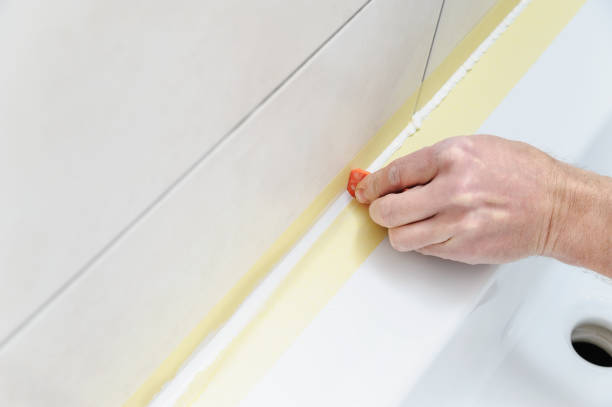
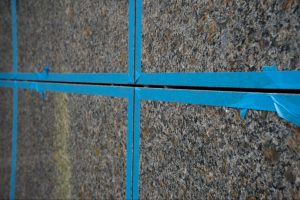
- Tape both sides of the joint. Painter’s tape gives straight edges and keeps silicone off the tile.
- Run a continuous bead. Work one joint at a time, since each needs tooling within five minutes.
- Tool within five minutes. Smooth the bead with a caulk tool, pressing it into the joint. A gloved finger works on short runs.
- Pull the tape and clean up. Remove the tape right after tooling and wipe off excess before the silicone skins over. Skinned-over sealant may need a commercial solvent.
| Item | Mapesil T Plus |
|---|---|
| Type | 100% silicone sealant |
| Environments | Interior and exterior, wet and dry; TCNA Res 1 to 6 and Com 1 to 6 |
| Standards | Exceeds ASTM and ANSI standards, per Mapei |
| Movement capability | ±25% (±50% for #23 Clear) |
| Joint width | Up to 1 inch; use closed-cell backer rod when the joint is deeper than 1/2 inch |
| Application temperature | 40°F to 90°F |
| Service temperature | -60°F to 400°F |
| Colors | Matched to Mapei’s grout color palette |
| Limitations | Not paintable; may stain porous natural stone, so test first |
The full Mapesil T Plus spec sheet is on Koffler’s product page for your submittal package.
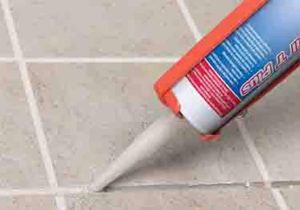
Mapesil T Plus 100% silicone comes in colors matched to Mapei grouts.
How Much Caulk a Shower Needs
A 10.1 oz cartridge covers about 11 linear feet of a 3/8 x 3/8 inch joint, or about 25 linear feet of a 1/4 x 1/4 inch joint.
Take off the linear feet of sealant joint per shower, multiply by the unit count, and divide by the cartridge coverage. For example, 100 units with 20 linear feet of 1/4 inch joint each need 2,000 linear feet, or 80 cartridges before waste.
Shower Caulk Cure Times for Scheduling
| Stage | Time | What it means on site |
|---|---|---|
| Tack-free | 10 to 20 minutes (ASTM C679) | Crews can move on; protect the joint from contact |
| Water and light traffic | At least 24 hours at 73°F (23°C) | Earliest the shower goes back into service |
| Heavy traffic | 3 to 5 days | For high-use commercial showers and locker rooms |
| Pools and spas | 7 days before filling | Also requires pH 6.5 to 7.6 and free chlorine under 5 ppm |
| Full cure | 28 days | Varies with temperature and humidity |
These times come from Mapei’s product sheet. Cooler or more humid rooms take longer, and Mapei notes some installations need more than 24 hours before a fingernail leaves no mark. In occupied buildings, take the shower out of service for the full 24 hours and add a day in cool or humid conditions.
How to Caulk a Shower in Occupied Buildings
In hotels, apartments and senior living, unit turnovers and scheduled maintenance are natural windows to recaulk. Caulk a shower with the same steps as above. Plan each unit around the 24 hour return-to-service window, and stock Mapesil T Plus in the colors that match the property’s grout so every unit gets the same finish.
How to Caulk a Shower: FAQs
How often should you recaulk a shower?
Lowe’s says most showers should be recaulked every one to two years, and sooner if the caulk cracks, peels or shows mold. In high-use commercial showers, check the sealant at every unit turnover.
Can I recaulk my own shower?
Yes. The steps to caulk a shower are the same for an owner or a maintenance crew. Most of the work is removing every trace of the old silicone so the new bead bonds.
Is it okay to smooth caulk with your finger?
A caulk tool gives a more even bead and keeps silicone off your skin. On a short run, a gloved finger works; wipe the glove between passes.
How long before a shower can be used after caulking?
With Mapesil T Plus, at least 24 hours at 73°F, longer in cool or humid rooms.
Should you caulk over grout?
No. Use silicone in change-of-plane and movement joints, and keep grout in the flat joints.
Can Mapesil T Plus be used in steam rooms and pools?
Mapei lists steam rooms and pools among its uses. For pools and spas, it requires 7 days of cure before filling.
Buy Mapesil T Plus in the color that matches your grout, or see Koffler’s full range of tile caulk and sealant. If the grout needs recoloring at the same time, Mapei Grout Refresh covers it.