
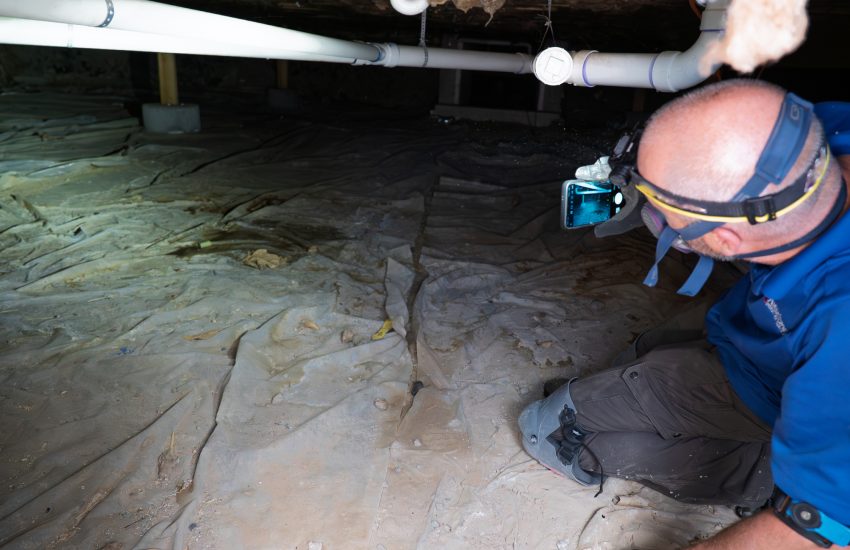
 Posted by
Install a crawl space vapor barrier by correcting water problems first, then laying the liner, overlapping and taping every seam, and carrying it up the walls and piers. In an unvented crawl space, IRC R408.3 calls for joints overlapped at least 6 inches and sealed or taped, with edges run at least 6 inches up the stem wall and sealed.
This guide covers crawl space vapor barrier code requirements, how to choose the liner, the install steps, common mistakes and ordering for large footprints.
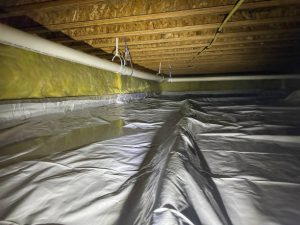
Crawl Space Vapor Barrier Code Requirements
The International Residential Code covers crawl spaces in Section R408. A crawl space is either vented (R408.2) or unvented (R408.3).
| Requirement | Unvented crawl space, IRC R408.3 |
|---|---|
| Ground cover | A continuous vapor retarder over all exposed earth |
| Seam overlap | At least 6 inches, sealed or taped |
| Wall extension | At least 6 inches up the stem wall, attached and sealed |
| Retarder type | A Class I vapor retarder in the model code; some state adoptions cite ASTM E1745 Class A |
| Conditioning | One of: continuous exhaust ventilation, conditioned air supply, dehumidification, or plenum use (existing buildings only) |
States adopt different editions and amend them. Confirm the retarder class and conditioning method with the local building department before you submit materials.
Choosing a Crawl Space Vapor Barrier
Check Class and Perm Rating for Submittals
Match the liner’s published class and perm rating to the code requirement for the job. Koffler’s product page lists its standard liners under ASTM E1745 Class C, and lists its 10 mil bright white liner as Class 1/Class A. Request the spec sheet for the exact liner you plan to submit.
Choose a Thickness
| Thickness | Best for | Notes |
|---|---|---|
| 6 mil | Vented crawl spaces that won’t be disturbed | Tears more easily under foot traffic |
| 10 mil | Occasional access, light encapsulation | Stronger and more puncture resistant |
| 12 mil | Damp crawl spaces, frequent foot traffic | Reinforced; a balance of cost and durability |
| 20 mil | Full encapsulation, high water tables | Highest puncture resistance; longest service life |
If plumbers, HVAC techs or pest control will be in the crawl space after you finish, spec heavier. A torn 6 mil liner is a callback.
Special-Purpose Liners
Koffler stocks fire-retardant 6 and 10 mil liners for projects whose spec or local code calls for them, plus antimicrobial liners. Its white liners reduce heat buildup and condensation.
Before You Install a Crawl Space Vapor Barrier
- Fix the water first. A liner blocks soil moisture but doesn’t remove standing water. Install drainage matting, and a French drain and sump pump where needed, before the liner goes down.
- Sequence the trades. Finish plumbing, electrical and HVAC work in the crawl space before the liner goes in, so other crews don’t puncture it.
- Confirm vented or unvented. It decides how far up the walls the liner goes and whether vents get sealed.
- Measure. Take floor area, wall height to be covered and pier dimensions, plus overlap allowance. Our encapsulation cost guide walks through a full takeoff.
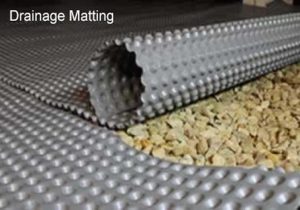
On wet sites, drainage matting goes down before the liner.
How to Install a Crawl Space Vapor Barrier in 8 Steps
- Clear and smooth the ground. Remove debris, old plastic, wood scraps and sharp stones.
- Lay the floor sheets. Start at the far end and work back toward the access. Run edges up the walls rather than stopping at the base.
- Overlap the seams. At least 6 inches to meet the IRC minimum for unvented crawl spaces. Koffler recommends 12 inches.
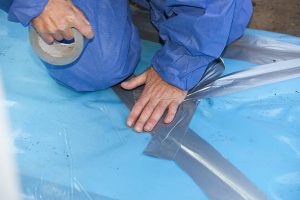
- Tape every seam. Seal each overlap with Vapor Bond seam tape.
- Run the liner up the walls. At least 6 inches up the stem wall, attached and sealed. Seal the top edge with butyl seal tape and pin it with ratchet fasteners. For full encapsulation, run it higher.
- Wrap the piers. Carry the liner up each pier and tape every cut.
- Seal the vents on unvented jobs. WhiteCap vent blocks compression-fit standard 8 x 16 inch openings.
- Walk it before the inspection. Check for tears, gaps and lifted tape, and repair them.
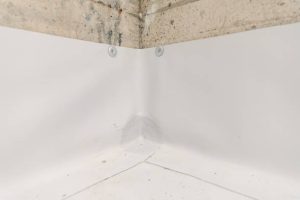
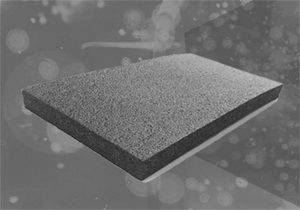
WhiteCap vent blocks seal standard foundation vents on unvented jobs.
Common Crawl Space Vapor Barrier Mistakes
- Liner over a water problem. The liner traps it. Fix drainage and leaks first.
- Untaped or short overlaps. Code requires at least 6 inches, sealed or taped.
- Liner stopped at the base of the wall. Code requires the 6 inch wall extension on unvented crawl spaces.
- Liner too thin for the traffic. Later trades tear 6 mil sheets.
- No conditioning plan. An unvented crawl space needs one of the code’s conditioning methods.
“People are often surprised that a crawl space drives the air quality of the whole house. After 40-plus years in moisture protection, my advice is simple: cover the ground, seal the seams, and carry the barrier up the walls. That barrier is a small cost set against mold and wood rot.”
Ron Starr, President and Co-Founder, Koffler Sales Company
Ordering Crawl Space Vapor Barrier for Larger Footprints
Koffler’s crawl space vapor barrier comes in 100 ft rolls:
- 6 mil reinforced clear: 6.17 to 60 ft wide
- 10 mil reinforced clear: 6.17 and 20 ft wide
- 12 mil white/black: 6.17, 12 and 24 ft wide
- 20 mil white: 6.17 to 24 ft wide (12 ft also comes in a 50 ft roll)
Wider rolls mean fewer seams to tape and inspect on large footprints. Order accessories with the liner: Vapor Bond seam tape (4 in x 180 ft), butyl seal tape (1.5 in x 108 ft) and ratchet fasteners (bags of 100 or 500).
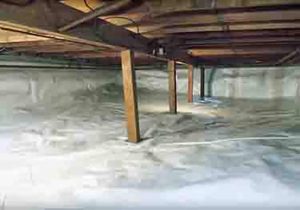
Koffler’s liners come in 100 ft rolls up to 60 ft wide, so large footprints need fewer seams.
Crawl Space Vapor Barrier FAQs
Is a vapor barrier required in a crawl space?
In an unvented crawl space, yes: IRC R408.3 requires a continuous vapor retarder over all exposed earth. In a vented crawl space, a Class I ground cover lets the builder use less vent area under R408.2. Check the edition your jurisdiction adopted.
How much does it cost to install a vapor barrier in a crawl space?
Liner material runs from about $0.22 per square foot for 6 mil to about $1.42 for 20 mil at Koffler’s listed prices. Our encapsulation cost guide has installed-price benchmarks and a takeoff method.
Does code require a specific liner thickness?
The R408.3 text we reviewed sets a retarder class, a seam overlap and a wall extension, not a mil thickness. Check your local adoption.
What seam overlap does code require?
At least 6 inches, sealed or taped, for unvented crawl spaces under IRC R408.3. Koffler recommends 12 inches.
Should the liner go in before or after other trades?
After. Finish work in the crawl space first so other crews don’t damage the liner.
Is it okay to put gravel under a vapor barrier in a crawl space?
Yes, as long as the surface is smooth with no sharp stones. The IRC sections above don’t require gravel. On wet sites, drainage matters more than the base.
Get liners, seam tape and vent blocks from Koffler’s crawl space moisture barriers category. For help sizing rolls on a large footprint, call 1-888-355-6287.