
 Posted by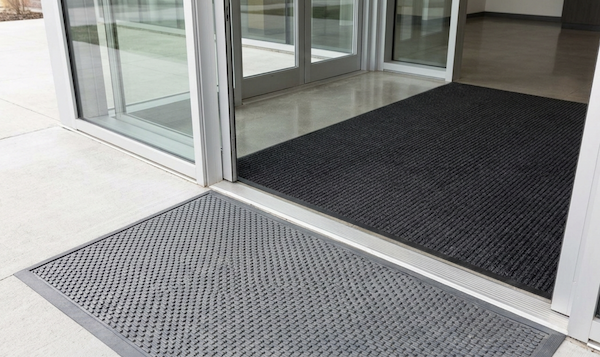
Commercial entrance mats do far more than look presentable. In hospitals, schools, warehouses, hotels, and office buildings, they’re working assets: trapping moisture, scraping debris, reducing slip-and-fall liability, and protecting the flooring underneath from premature wear.
The challenge is that a mat that works perfectly in one setting can fail in another. A lightweight residential mat won’t survive a week in a grocery store vestibule. A heavy rubber scraper mat might be overkill in a boutique hotel lobby.
This guide breaks down the types of commercial entrance mats available, how to match them to your facility, and what to look for so you’re not replacing them every six months.
Why Commercial Entrance Mats Matter
The vast majority of dirt in a building gets tracked in through the front door. That tracked-in soil, sand, grit, salt, moisture, grinds into flooring with every footstep, dulling finishes, scratching hard surfaces, and embedding into carpet fibers in ways no amount of vacuuming fully reverses.
Beyond flooring damage, wet entryways create real safety hazards. The National Floor Safety Institute (NFSI) reports that slip-and-fall accidents account for millions of emergency room visits per year in the U.S., and a significant share happens at building entrances during wet weather. A well-chosen commercial entrance mat addresses both problems at once.
The Hidden Cost of the Wrong Entrance Mat
Facility managers tend to notice mat failure in hindsight: curled edges that become trip hazards, saturated mats that stop absorbing and start spreading moisture, or undersized mats that only catch the first step’s worth of debris.
The downstream costs add up from more frequent floor refinishing, higher janitorial hours, and in the worst case, liability claims from slip-and-fall injuries. Of all the top floor protection products a facility can invest in, commercial entrance mats consistently deliver one of the highest returns. Investing in the right commercial entrance floor mats upfront almost always costs less than dealing with the problems a cheap or wrong mat creates.
Types of Commercial Entrance Mats
The right choice depends on your traffic volume, climate, whether the mat sits indoors or outdoors, and what kind of contaminants you’re dealing with. Here’s a breakdown of the major categories.
-
Scraper Entrance Mats
Scraper mats are the workhorses of outdoor and vestibule matting. They use aggressive surface textures like raised rubber fingers, coarse bristles, or rigid patterns to physically dislodge heavy dirt, mud, gravel, and snow from shoe soles. They’re not designed for comfort or moisture absorption; they’re designed to do the heavy lifting so the mats inside don’t have to.
Best for: building exteriors, loading docks, factory entrances, and any location where people are coming in from unpaved or heavily soiled areas.
Our Recommendation: Surefoot Floor Mat
-
Wiper and Carpeted Entrance Mats
Where scraper mats handle the heavy debris, wiper mats handle the fine particles and moisture that remain. These typically feature nylon or olefin carpet fibers bonded to a rubber backing. They’re the most common type of indoor commercial entrance mat and strike a good balance between dirt capture, moisture absorption, and appearance. Needle-rib and plush-style mats fall into this category, available in a range of colors that suit lobbies and reception areas.
Best for: interior entryways, lobbies, hallways, and anywhere aesthetics matter alongside function.
Our Recommendation: Colorstar™ Plush Mat
-
Waterhog and Bi-Level Entrance Mats
Waterhog products are an industry standard for commercial entrance matting. Their signature raised waffle pattern scrapes shoe soles from multiple angles while channeling water and debris into recessed wells below the surface. The reinforced rubber border acts as a dam, holding up to 1.5 gallons of water per square yard.
Bi-level tile systems take this further. Interlocking 18″ x 18″ tiles create a modular surface where dirt and sand fall beneath the walking level entirely, stored out of sight until cleaning.
Best for: high-traffic commercial entrances, vestibules, lobbies, recessed mat wells, and elevator landings.
Our Recommendation: Waterhog Classic Entrance Mat
-
Rubber Entrance Mats
Molded rubber mats are built for punishment. They resist moisture, chemicals, UV exposure, and temperature extremes, and they’re easy to clean, all you need to do is just hose them off. Their textured surfaces provide reliable traction in wet conditions, and they won’t break down from road salt or deicing chemicals the way fabric-based mats can.
Best for: industrial entrances, outdoor applications, loading areas, and facilities dealing with chemicals or heavy equipment traffic.
Our Recommendation: Sof-Tred-Tyle Anti-Fatigue Floor Mat
-
Aluminum and Recessed Metal Mats
At the top end of the durability spectrum are aluminum-framed entrance systems with interchangeable carpet, rubber, or abrasive inserts. These are designed to be recessed into the floor—flush with the surrounding surface—and engineered for extremely high-traffic facilities like airports, transit stations, and large hospitals. Galvanized steel scraper mats offer a more portable option for factory entrances and ramps.
Best for: ultra-high-traffic entrances, architectural installations, and facilities that require ADA-compliant flush transitions.
Our Recommendation: Flexible Steel Floor Mat
-
Vinyl Entrance Mats
Vinyl-loop mats use dense loops of PVC to create a scraping and drainage surface that doesn’t absorb moisture at all. Water and debris fall through the loops, keeping the walking surface dry. They’re lightweight, easy to cut to size, and resist mildew.
Best for: covered entrances, food service entry points, pool areas, and locations where drainage matters more than absorption.
Our Recommendation: KSC Tile Cord Mat
-
Coir Entrance Mats
Coir mats are made from natural coconut husk fibers. They offer excellent scraping action and a warm, traditional look that suits hospitality, retail, and residential property entrances. They’re biodegradable and effective at removing dry debris, though not the best choice for heavy moisture. Available in a variety of widths and thicknesses, they can serve as standalone mats or as the outdoor component of a multi-zone system.
Best for: retail entrances, hotels, residential buildings, and dry-climate facilities where a natural look is desired.
Our Recommendation: Fiber King Cocoa Floor Matting
-
Logo and Branded Entrance Mats
Custom logo mats combine functional entrance matting with branding. A company’s logo or design is digitally printed or inlaid into a durable nylon-and-rubber mat that performs just as well as its unbranded equivalents, while reinforcing brand identity at the front door.
Best for: corporate lobbies, retail storefronts, restaurants, and any business that wants its entrance to do double duty.
Our Recommendation: Waterhog Custom Logo Inlay Mat
The Three-Zone Matting System Explained
Facility and flooring professionals often recommend a three-zone approach for buildings with high foot traffic. Rather than relying on a single mat, this system uses three sequential zones to progressively clean footwear:
Zone 1 — Exterior scraping. A heavy-duty scraper or rubber mat outside the door removes the bulk of dirt, mud, and debris.
Zone 2 — Transitional scraping and absorption. A Waterhog-style or bi-level mat in the vestibule or just inside the door handles remaining grit and begins wicking moisture.
Zone 3 — Interior wiping and drying. A carpeted wiper mat further inside captures fine particles and finishes drying shoe soles.
When implemented properly, this system removes the vast majority of tracked-in contaminants before they reach your interior flooring. The industry rule of thumb is that the combined matting should provide 10-15 feet of walk-off distance from the exterior door, roughly six to eight steps.
How to Choose the Right Commercial Entrance Mat
Sizing Your Entrance Mat Correctly
This is where many facilities go wrong. An undersized mat only captures one or two footfalls which are not nearly enough to meaningfully reduce soil and moisture transfer. For effective performance, a commercial entrance mat should cover the full width of the doorway and be long enough to give each foot at least three full contacts with the surface.
In practice, that means a minimum of six feet in length, and longer for heavy traffic. For vestibules and recessed wells, modular tile systems allow coverage of larger areas without a single unwieldy mat.
Safety Standards and Compliance
Commercial mats for entrances should meet relevant safety and accessibility standards. NFSI certification confirms adequate slip resistance. ADA compliance matters for recessed and framed systems. For instance, the mat surface should be flush or nearly flush with the surrounding floor to prevent trip hazards and allow wheelchair access. Fire ratings may be required in healthcare and education facilities; check with your local code authority if unsure.
Also pay attention to edge design. Mats with beveled or tapered edges are significantly less likely to curl or create trip hazards, especially under rolling cart traffic.
Maintenance and Longevity
Even the best commercial entrance mats need routine care to keep performing. For carpeted and Waterhog-style mats, regular vacuuming is essential. Periodic deep cleaning with an extractor or pressure washer restores absorption capacity. Rubber and vinyl mats can typically be hosed off and left to air dry.
Modular tile systems have a practical advantage here: individual tiles can be removed, cleaned separately, and rotated to distribute wear evenly.
Inspect edges and backings monthly. Curled edges and cracked rubber are both trip hazards and signs that a mat is due for replacement. Most quality commercial mats last two to five years depending on traffic volume and maintenance, though aluminum and recessed systems can last significantly longer.
Choosing the Right Entrance Mat Starts Here
The best commercial entrance mats aren’t necessarily the most expensive, they’re the ones that match your facility’s traffic, climate, and functional needs. A three-zone system with properly sized mats will outperform a premium single mat every time. Prioritize the right type and size for each zone, stay on top of maintenance, and your floors, your cleaning budget, and your visitors will all benefit.
Frequently Asked Questions
What are the best commercial entrance mats for high-traffic buildings?
Waterhog mats and bi-level tile systems are among the most popular choices. They combine aggressive scraping with high moisture retention and are available in configurations suited to vestibules, lobbies, and recessed mat wells.
How long should a commercial entrance mat be?
A minimum of six feet, enough for at least three full footfalls per foot. For a complete three-zone matting system, aim for 10-15 feet of total walk-off distance from the exterior door.
What’s the difference between a scraper mat and a wiper mat?
Scraper mats use coarse, rigid surfaces to dislodge heavy debris like dirt, gravel, and snow. Wiper mats use absorbent fibers to capture fine dust and moisture. Most facilities benefit from using both scraper mats outside, wiper mats inside.
What’s the best commercial entrance mat for rubber flooring?
Mats with rubber or nitrile backings tend to grip well on commercial rubber flooring without causing discoloration or chemical reaction. Waterhog mats and rubber-backed wiper mats are both solid choices. In general, avoid mats with vinyl backings on rubber floors, as they can leave marks or slide. If you’re using recessed mat wells, the backing is less of a concern since the mat sits inside the well rather than on the floor surface.
How often should commercial entrance floor mats be cleaned?
In high-traffic facilities, carpeted mats should be vacuumed daily and deep-cleaned monthly. Rubber and vinyl mats should be hosed off weekly or as needed. Regular cleaning is the single biggest factor in maintaining a mat’s performance and lifespan.
Do commercial entrance mats reduce maintenance costs?
Significantly. Effective entrance matting can reduce interior cleaning costs by capturing the majority of tracked-in soil and moisture before it reaches finished flooring. It also extends flooring lifespan by reducing abrasive wear, meaning less frequent refinishing or replacement.